
Software Reconciliation
Unified License Optimization
Eracent’s Reconciliation Management automatically checks software usage against license rights to keep information accurate. By combining data from discovery, purchasing, and licenses, it gives one clear view that helps optimize licenses, improve financial accuracy, and support better vendor negotiations.
- Overview
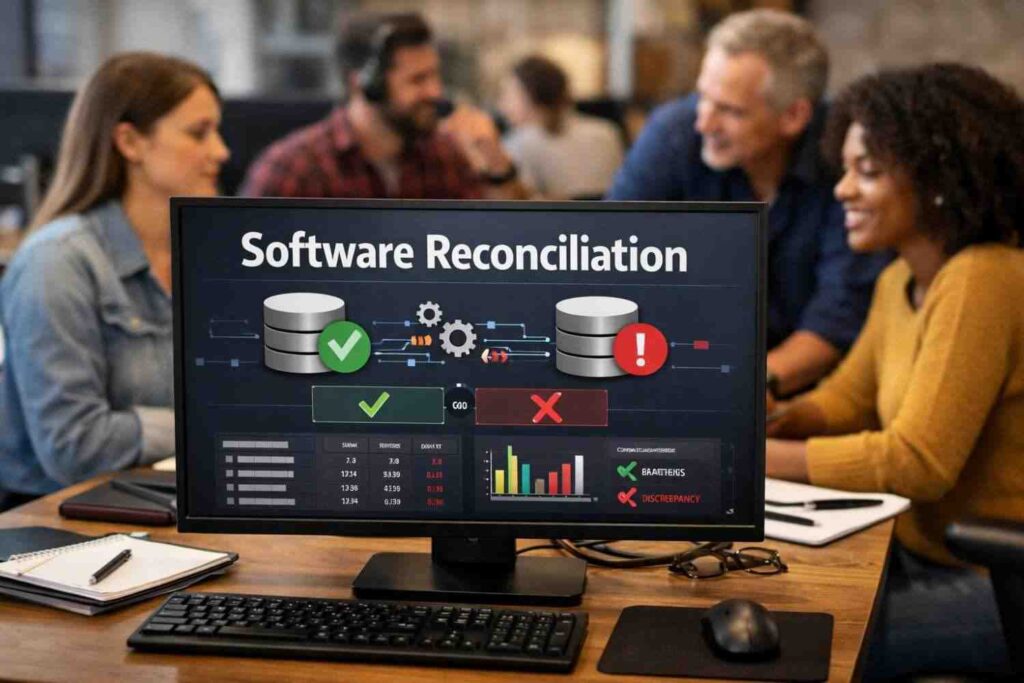
Eracent’s Reconciliation Management capability empowers organizations to validate software usage and entitlements through continuous, automated reconciliation. By consolidating discovery, procurement, and entitlement data, Eracent delivers a single source of truth for software asset management enabling precise license optimization, financial accuracy, and vendor negotiation power. The Continuous License Reconciliation (CLR) engine ensures that every deployment aligns with purchased entitlements, eliminating discrepancies and providing a trusted financial and operational foundation for enterprise IT decision-making.
- Business Context
Organizations frequently struggle with inconsistent data from multiple discovery tools, disparate vendor invoices, and varying contract terms.
This fragmented visibility leads to:
- Inaccurate license positions and inflated software spend.
- Redundant or unused software purchases across departments.
- Difficulties in justifying costs during financial audits or vendor negotiations.
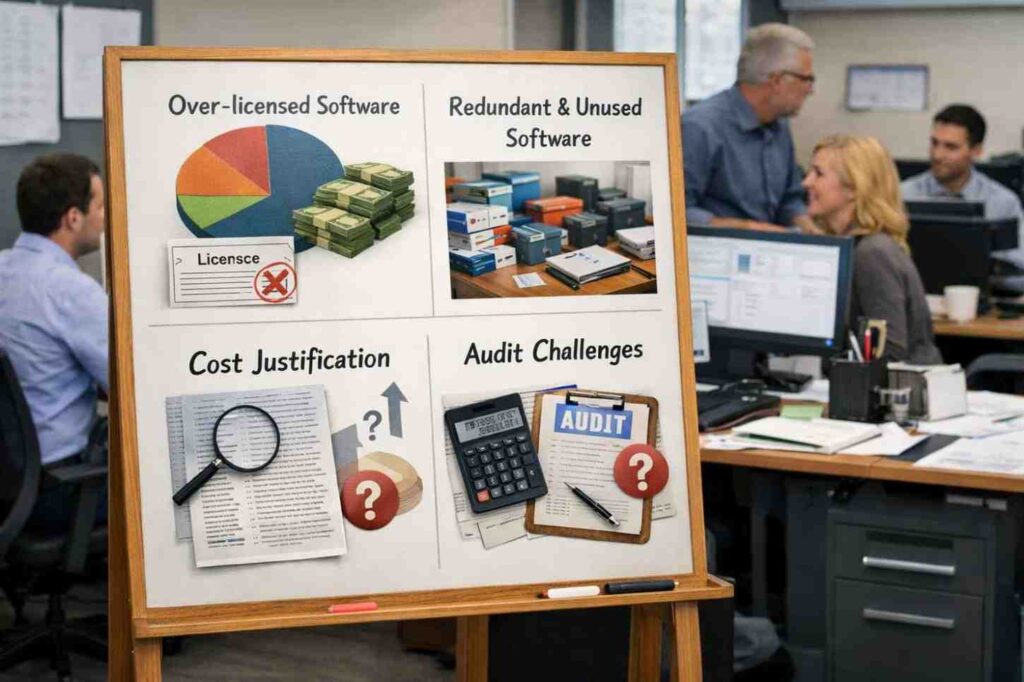
Eracent addresses these challenges through automation and intelligence delivering financial reconciliation accuracy, spend control, and cross-departmental visibility.
- Actors
IT Asset Manager:
Oversees data accuracy and reconciliation governance.
Procurement Officer:
Verifies vendor invoices and entitlement contracts.
Finance Executive:
Ensures financial consistency and validates IT expenditure.
- Preconditions
- License procurement, entitlement, and deployment data are integrated into Eracent’s repository.
- Vendor licensing metrics and contract terms are configured in the system.
- Reconciliation frequency and reporting parameters are established.
- Functional Flow
- Data Consolidation: Eracent aggregates entitlement data from procurement systems and correlates it with real-time software usage from discovery tools.
- Normalization & Cleansing: Product names, versions, and editions are standardized using IT-Pedia for accurate matching.
- Automated Reconciliation: The CLR engine compares discovered installations against entitlements, identifying surpluses and deficits.
- Financial Validation: Discrepancies between vendor invoices and actual license usage are flagged for review.
- Optimization Insights: The system provides actionable insights highlighting opportunities to reclaim, reassign, or reallocate licenses.
- Reporting & Governance: Dashboards display reconciled positions, utilization rates, and spend summaries, providing transparency across IT, Procurement, and Finance.
- Key Functional Advantages
- Centralized License Intelligence: Consolidates data from multiple systems to ensure one accurate compliance view.
- Real-Time Reconciliation: Continuous updates reflect the current state of entitlements and usage.
- Vendor Invoice Validation: Prevents overbilling and enables proactive spend correction.
- Integration Flexibility: Seamlessly connects with ERP, procurement, and financial management tools.
- Strategic Benefits
- Financial Accuracy: Establishes a reliable foundation for budgeting and reporting.
- Operational Transparency: Gives executives a holistic view of software usage and entitlement efficiency.
- Procurement Optimization: Prevents unnecessary renewals or redundant purchases
- Vendor Negotiation Power: Strengthens leverage with precise, validated usage data.
- Business Impact
Through continuous reconciliation, Eracent delivers a sustainable cost optimization framework that aligns IT operations with business strategy.
Organizations experience measurable reductions in software waste, improved financial reporting integrity, and complete control over license assets.
Ultimately, Eracent’s reconciliation capability transforms asset management into a strategic advantage, driving both financial performance and operational accountability.
