
IT Asset Discovery
The Essential Foundation: Unlocking Power Through IT Asset Discovery and Visibility
In today’s enterprises, IT is essential for running operations, driving innovation, and managing data, yet many organizations don’t clearly know what IT assets they actually have. This lack of awareness creates serious risks, which is why IT Asset Discovery and IT Asset Visibility are crucial for strong management, security, and financial control.
Overview:
In the modern enterprise, information technology is not merely a support function; it is the central nervous system. It powers operations, drives innovation, and stores the lifeblood of the organization: its data. Yet, many companies operate without a complete picture of core component of this system—their IT assets. This blind spot is not just an operational inefficiency; it is a critical business risk. The remedy lies in two interconnected disciplines: IT Asset Discovery and the resulting IT Asset Visibility. This is not a niche technical concern but a foundational element of strategic management, security, and financial health.
What is IT Asset Discovery?
IT Asset Discovery is the active process of identifying and cataloging all hardware and software assets within an organization’s IT environment. It is the “how” of achieving visibility. Think of it as conducting a continuous, automated census of your digital estate.
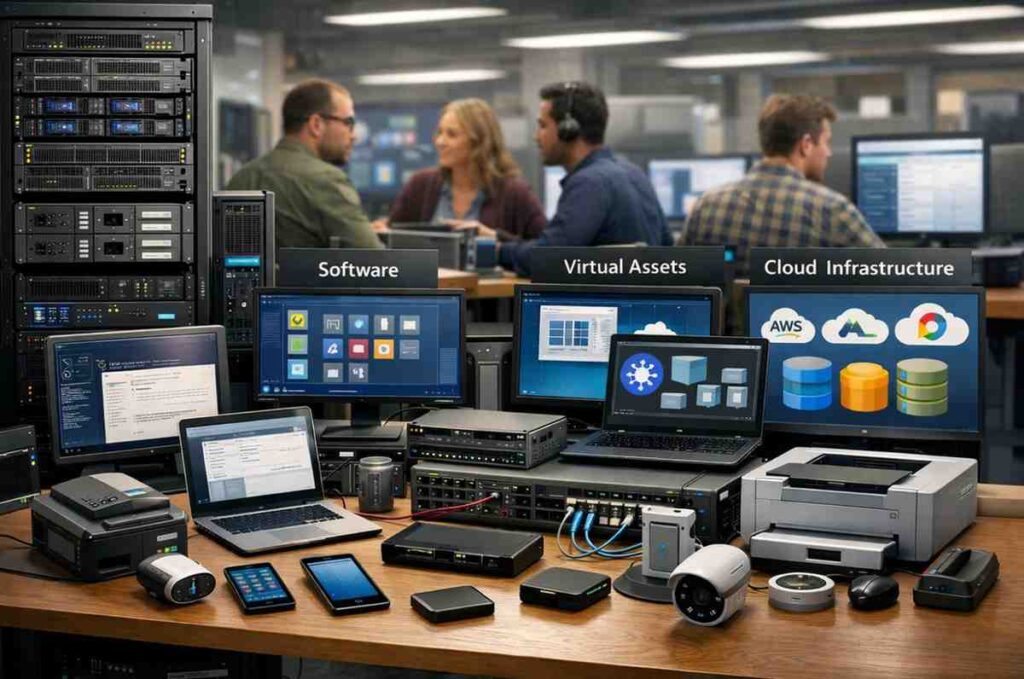
Modern IT environments are dynamic, fluid, and sprawling, encompassing:
- On-premises hardware: Servers, desktops, laptops, mobile phones, tablets, printers, network switches, and IoT devices.
- Software: Operating systems, installed applications, proprietary software, and cloud-based services (SaaS).em
- Virtual Assets: Virtual machines (VMs) and containers, including Kubernetes.
- Cloud Infrastructure: Instances, storage buckets, and databases in public clouds like AWS, Azure, and Google Cloud Platform.
Methods of Discovery:
Enterprise-class discovery tools – including Eracent’s ITMC Discovery™ – employ various techniques to paint this complete picture:
- Agent-Based Discovery: A very small software agent is installed on each device (e.g., laptops, servers). This agent collects detailed, granular data about the device's hardware configuration, installed software, and performance, often even when the device is off the corporate network.
- Agentless Discovery: This method uses network protocols like SNMP (Simple Network Management Protocol), WMI (Windows Management Instrumentation), and SSH (Secure Shell) to scan the network and query devices remotely. It's faster to deploy but can sometimes provide less detailed information than an agent, especially for mobile or offline assets.
- Passive Network Monitoring: ITMC Discovery™ Enterprise Network Probe analyzes network traffic to identify devices and applications communicating on the network. This is excellent for finding "shadow IT" or unauthorized devices that other methods might miss.
- Cloud API Integration: Modern discovery platforms like ITMC Discovery™ directly integrate with cloud service providers' APIs to inventory all active resources, configurations, and services within an organization's cloud tenancies.
- Import from Existing Systems: Data can be imported from existing management systems like Microsoft SCCM, Active Directory, or CMDBs, though these often need to be supplemented with more dynamic discovery methods.
The output of IT Asset Discovery is a centralized, living inventory—a single source of truth that answers the fundamental questions: What do we have? Where is it? Who is using it?
Why IT Asset Visibility is a Non-Negotiable Must-Have
If Discovery is the process, then IT Asset Visibility is the outcome—the state of having a real-time, accurate, and comprehensive understanding of your IT estate. This is not a “nice-to-have” for large enterprises; it is an absolute necessity for any organization that uses technology.
Eracent’s Discovery Solutions:
Eracent’s ITMC Discovery™ provides a wide range of discovery, inventory and utilization functionality for all platforms – from data centers and servers to end-user PCs and mobile devices.
Network device detection (Network Probe) – Detects servers, PCs, hubs, switches, routers, parent and child relationships, and more.
Cross-platform network discovery for Windows, all flavors of UNIX, Solaris, True64, HPUX, Linux, Mac, AIX, AS/400 and Android devices. Complete and accurate details are provided about machine configuration, installed software, peripherals and more.
Agentless or agent-based scanning, with the same results and degree of accuracy/completeness.
Scanning of virtual environments, with reporting on the relationships between physical hosts and virtual guests. Environments currently include VMWare ESX, Solaris Zones and AIX LPARS and Microsoft Hyper-V, among others. Virtual Application detection is provided for Microsoft App-V/Softgrid, Citrix XenApp, and VDI/Thin Client environments.
Software ID Tag Detection – Supports the detection and reporting of software ID tags that meet the ISO 19770-2 standard, as well as other readable tags.
Software Utilization monitoring – Can monitor the usage of specified products down to the keystroke and mouse-click level. While an organization may be compliant based on purchases-to-installations, if nobody is using a license actively, there may be savings opportunities (e.g., re-allocate licenses, scale back maintenance, utilize free viewers or concurrent licenses for less frequent users).
Software Distribution – Enables the creation and deployment of .msi, .pkg and .rpm packages. In the package builder, instructions may be defined for silent (no user interaction) installation and uninstallation of these packages. The deployment package may be configured to target devices based on hardware attributes, whether particular applications are or are not installed on a given machine, or a combination of these.
ITMC Discovery can also assist with the distribution process performed by SCCM by identifying all target machines based on hardware attributes, whether particular applications are or are not installed on a given machine, or a combination of these. This list of machines can then be sent directly to an existing SCCM collection, or a new SCCM collection can be created and populated. All of these actions can be performed within the product interface.
Connections to Third-Party Discovery
The ability to share asset and license information seamlessly and automatically with complementary business applications is essential. It is equally important for ITAM and SAM tools to be able to take advantage of data that resides in other systems. Sharing this data enables organizations to get more out of their investment in existing tools and processes. To facilitate the sharing of discovery and usage data, Eracent provides multiple connection options.
EDEs and EDIs
Eracent provides specialized Eracent Data Extractors (EDEs) and Eracent Data Integrators (EDIs) to import data from third-party discovery and usage tools. This enables data from all discovery tools that are in use across various platforms, business units and geographical locations to be incorporated into a single database for a consolidated view of the complete network environment. This data is processed by the SCANMAN™ normalization process to ensure that common naming conventions are utilized, making the data more useful and relevant for multiple purposes. The system also identifies any duplicate records for machines that were scanned by multiple discovery tools. This avoids double counting to ensure accuracy in license reconciliation and optimization reporting.
EDEs and EDIs are provided for commonly used tools such as:
- Amazon Web Services
- Citrix Cloud
- Citrix XenApp
- HCL BigFix
- HP DDMA
- HP Universal Discovery
- HP UCMDB
- IBM MaaS360
- Jamf
- LANSweeper
- Microsoft Azure
- Microsoft Intune
- Microsoft Office365
- Microsoft SCCM
- MobileIron
- Okta
- OpenStack
- Pulsus MDM
- ServiceNow Discovery
- Symantec Altiris
- TADfD
- Tivoli
- VMWare AirWatch
- XEN
From Cost Center to Value Creator
IT Asset Discovery and Visibility transcend their technical origins to become a cornerstone of modern business management. They are the critical link between the chaotic, distributed reality of today’s IT environments and the strategic goals of security, efficiency, and growth.
